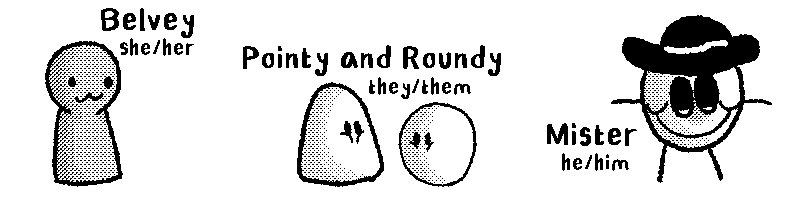
Since all doodle beings come into existence through discrete instances of abiogenesis, they have nothing that resembles a reproductive system, and are in essence biologically sexless. However, they do possess a loose and floaty sense of gender identity inherited from the imaginations of the humans in the “real” universe from which Doodle draws its semantic meaning.
A minority of doodle beings identify strongly with a binary human gender, and are referred to with its associated pronouns (e.g. “she” or “he”). This may be because some aspect of their physical form carries gendered associations in the “real” universe, or merely from personal preference. Since doodle being sapience is fairly rudimentary, it is unlikely that a gendered doodle being would possess the interiority to explain why they identify the way that they do if asked about it. Curiously, most gendered doodle beings are anthropoids.
A majority of doodle beings belong to the broad category of “just some guy,” a grouping they consider gender-neutral, with such individuals being referred to either by name or with “they” pronouns. Of course, the word “guy” is not actually gender-neutral, and carries male connotations. This is because, as beings born from bursts of human imagination, doodle beings unconsciously replicate androcentric notions of maleness as default found in human cultures. Unfortunately, this is another thing that doodle beings may not be sapient enough to interrogate.
Though much of the semantic meaning that reaches Doodle is abstract and scrambled, cultural changes in the “real” world do affect the sorts of doodle beings that get made, and how they feel about themselves. Historically, “he” was the dominant pronoun that doodle beings used, along with other gendered terms such as “chap” or “fellow.”